Key findings
- The compiled working set led the deployable methods, reaching 81.76% accuracy for the 4B reader and 90.00% for 9B.
- Recent-history accuracy declined as the generated history grew, while the compiled working set remained stable or improved.
- The 9B reader was more accurate than the 4B reader under every deployable memory interface.
- The result identifies a pattern worth testing across different histories and model families, not a universal ranking of memory systems.
What memory means here
Mneme (pronounced NEE-mee) takes its name from the Ancient Greek mnēmē, meaning memory. A language model answers from the information available in its immediate working context. It does not automatically carry a complete record of earlier interactions from one answer to the next. A memory system reconnects the model with that past by deciding what to preserve, what to retrieve, and how to present it when the model needs it.
By shape, we mean the form that remembered information takes when it reaches the model. In this study, the model that answers is the reader, and the form in which stored history reaches it is the memory interface. Each experimental memory condition implements one memory method. The same past can arrive as a chronological log, a set of search results, linked facts, separate fields, or a compact account of the current state. Each form changes both what the model sees and what it must work out before it can answer.
The right fact may arrive too late, sit inside pages of routine history, or reach the model in a form that obscures how it relates to the question. This study follows the path from stored history to the model's answer and asks how much that final presentation changes the result.
Study design
Nine memory conditions, the same worlds and questions
A fair comparison required histories in which the correct state was known at every step. We therefore generated 256 fictional worlds from one fixed event-and-question template, changing the people, projects, objects, dates, and other tokens in each version. Every world contained the same schedule of decisions, revisions, tasks, noise events, and nine question types.
Every memory method received the same underlying worlds and questions. We measured each history after 4, 16, and 64 sessions (9, 47, and 194 generated event records before shared eligibility filtering) and gave the models two different amounts of working context. This paired design let us change the memory interface without changing the events behind it. In total, the study produced 248,832 scored answers across 864 experimental cells.
- Scored answers
- 248,832
- Fictional worlds
- 256
- Memory conditions
- 9
- Session checkpoints
- 4 · 16 · 64 sessions
- Context budgets
- 4,096 · 8,192 tokens
What the models had to remember
The questions asked for more than simple fact lookup. A useful memory must preserve events, follow changes, connect related records, and distinguish information that still applies from information that should be set aside.
Why these two models
We used Qwen 3.5 4B and Qwen 3.5 9B from the same open-weight model family. The smaller model has about four billion parameters and the larger one about nine billion. This provided a narrow comparison of how two model sizes from one family responded to the same memory interfaces.
Memory conditions
How the past reached the reader
We tested nine conditions: no memory, recent history, lexical retrieval, vector retrieval, graph retrieval, hybrid retrieval, typed memory, compiled state, and a diagnostic expected-evidence selector. Every condition began with the same histories and questions. A shared eligibility rule removed private, deleted, and superseded records and kept the latest authorized record for each state key. After that common step, the conditions differed in what they selected and how they presented it to the model. Seven represented deployable designs. No memory supplied no stored history. The diagnostic selector, labeled Oracle in the experiment files, supplied the records expected to answer each question as a research comparison, not a live method or a performance ceiling.
No memory
The model received only the question and an explicitly empty authorized-memory block. This showed how well it could answer without stored history.
Recent history
After shared privacy, deletion, and revision rules were applied, the model received as many of the newest authorized events as the context budget allowed.
Lexical retrieval
The system looked for stored text that shared words with the question and returned the closest matches.
Vector retrieval
The system searched for memories with a similar meaning, even when the question used different words.
Graph retrieval
The system took the four highest-ranked keyword matches as seeds, then expanded two hops through shared entity strings for people, projects, components, databases, relays, and distractor tokens.
Hybrid retrieval
The system fused keyword, meaning, linked-record, and recency rankings, then returned up to 24 authorized events.
Typed memory
The system used the same fused event selection as Hybrid retrieval, then labeled each record with its memory type, session, and provenance.
Compiled state
The system used the same fused event selection as Hybrid retrieval, then presented the records as a compact bullet list under a current-working-set heading.
Diagnostic expected-evidence selector
This diagnostic expected-evidence selector, labeled Oracle in the study, supplied the records expected to answer each question. It was a research comparison, not a method a live system could use.
Results
The compiled working set had the highest deployable accuracy
The Hybrid, Typed, and Compiled conditions began with the same fused selection of up to 24 authorized records. Hybrid retained session tags. Typed added memory-type and provenance tags. Compiled removed those tags and presented the records as plain bullets under a “CURRENT AUTHORIZED WORKING SET” heading.
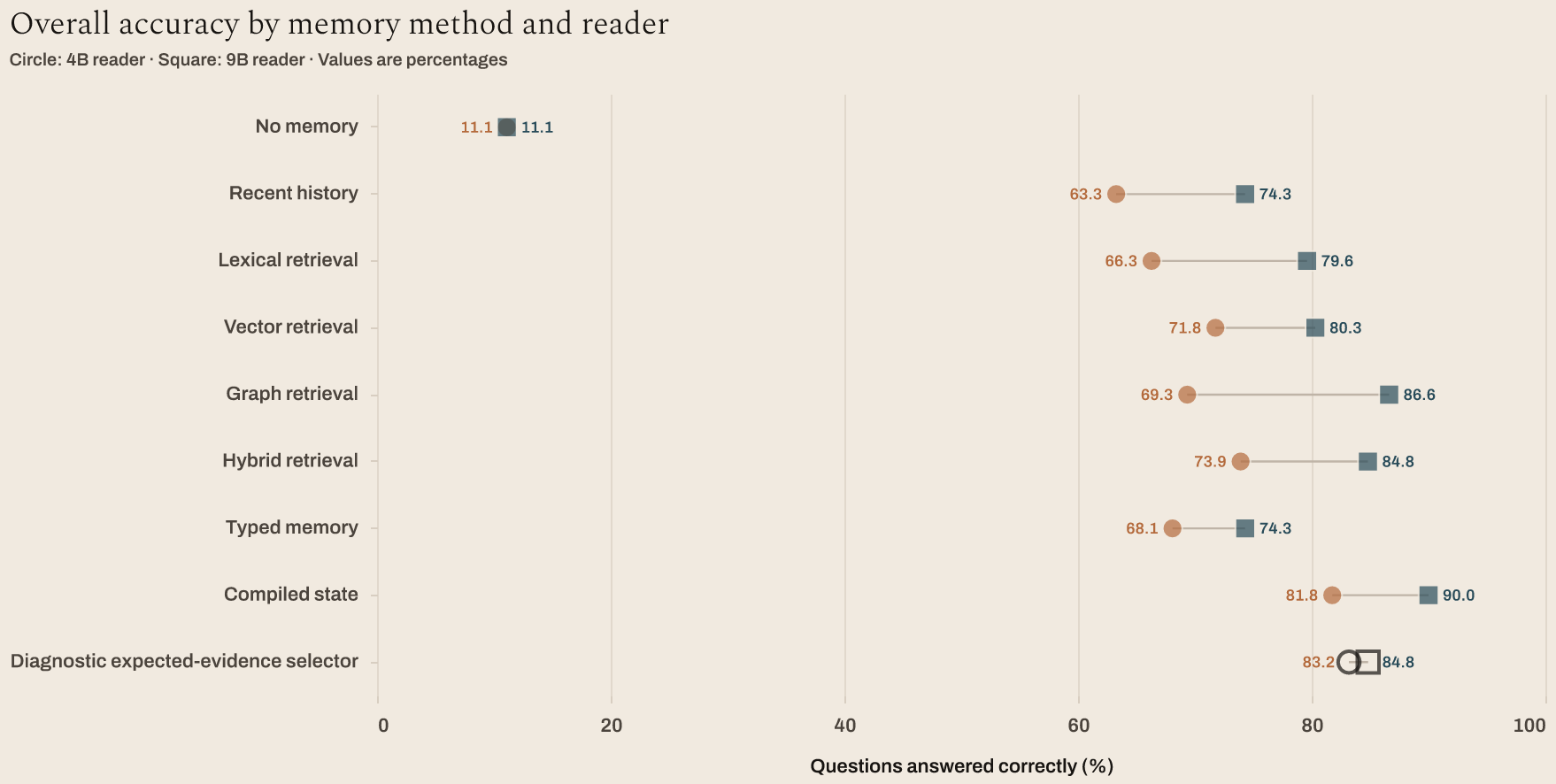
That compact presentation achieved the highest overall accuracy among the seven deployable methods. The 4B model answered 81.76% of questions correctly, and the 9B model reached 90.00%. Because Hybrid, Typed, and Compiled began with the same record ranking, their separation points to the reader-facing representation rather than to a different retrieval result.
Full chart description
Each row is one memory method. A circle marks Qwen 3.5 4B and a square marks Qwen 3.5 9B on a zero-to-100-percent accuracy scale. Hollow marks identify the non-deployable diagnostic expected-evidence selector. The no-memory baseline is 11.11% for both readers, so those two markers coincide. Compiled state is the rightmost deployable row for each reader.
The hollow diagnostic markers show the expected-evidence selector. It was included for comparison and was not a deployable memory method or a performance ceiling.
The clearest difference appeared as history grew
Recent history gave the model a chronological window of the newest authorized events. At session 4, the generated history contained 9 event records. At session 64, it contained 194 raw records and 189 records after shared eligibility filtering. The longer window carried far more routine noise, and the 4,096-token condition could retain only part of it.
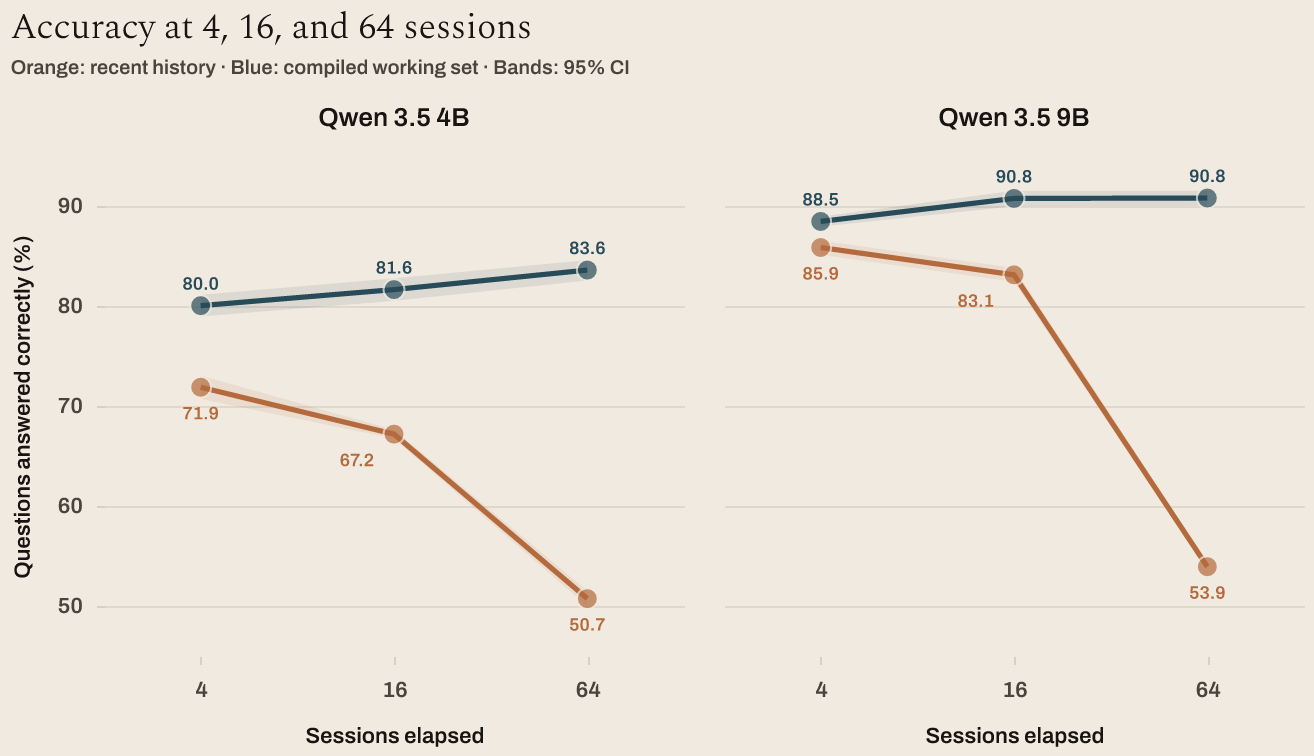
The difference was visible in both readers. From the 4-session to the 64-session checkpoint, recent-history accuracy fell from 71.88% to 50.74% for 4B and from 85.85% to 53.93% for 9B. The compiled working set did not show the same decline.
Full chart description
The 4B and 9B panels each contain three measured session horizons on a 45%-to-95% vertical scale. Compiled-state accuracy rises slightly across the checkpoints. Recent-history accuracy declines modestly at 16 sessions and sharply at 64 sessions, with the larger decline in the 9B panel.
The shaded bands are exploratory 95% confidence intervals and were not adjusted for multiple comparisons.
Compiled state used about one quarter as much input
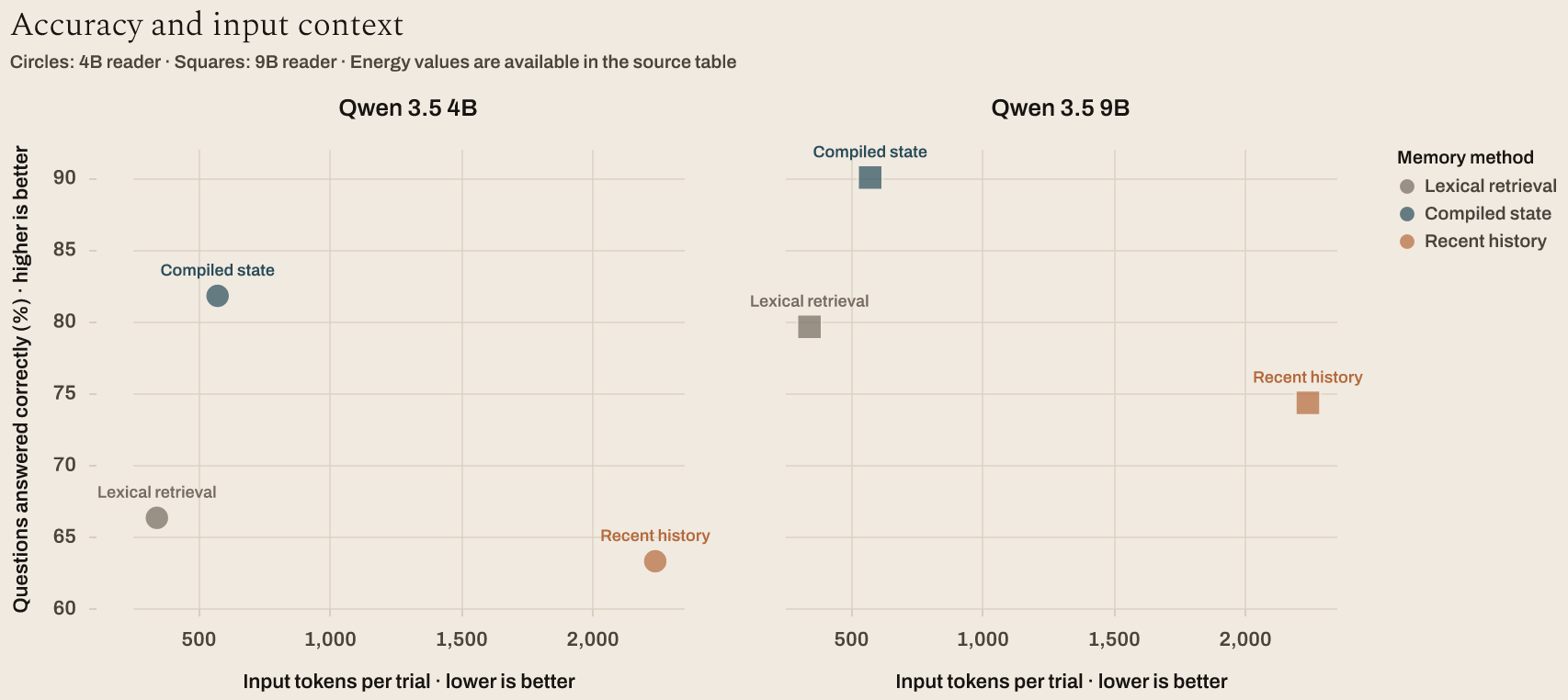
Recent history used about 2,241 input tokens per question. Compiled state used about 575, roughly one quarter as many, while producing more correct answers. Input tokens are the pieces of text the model had to read before answering.
The compiled condition changed the serialization of the fused working set: it removed session, type, and provenance tags, added a working-set heading, and used compact bullets. This experiment measured their combined effect. A follow-up study will need to vary those elements one at a time to learn which parts supplied the gain.
Full chart description
Lexical retrieval uses the fewest input tokens. Compiled state uses more than lexical retrieval but much less than recent history, and it has the highest accuracy in both reader panels. Both axes focus on the observed range rather than beginning at zero.
The axes focus on the observed range so the differences remain legible; neither axis begins at zero.
What the result means
The memory interface changed what the reader had to work through. Recent history supplied a growing chronological window that included large amounts of routine noise. The fused conditions selected a much smaller set of records. Among those fused conditions, the compact compiled serialization outperformed the session-tagged hybrid form and the type-and-provenance-tagged form even though all three began with the same record ranking.
The result is therefore not evidence that one retrieval algorithm was better than another. It shows that the reader-facing serialization of the same fused selection coincided with large accuracy differences. Because the compiled treatment changed its heading, tags, and formatting together, the experiment cannot yet identify which element contributed most.
The reader mattered as well. The 9B model was more accurate than the 4B model under every deployable interface. Because the two models differ in more than parameter count, the study does not identify model size itself as the cause.
Limits and evidence
This study provides evidence about a memory-interface pattern, not a verdict on every possible memory system. It used two models from the Qwen 3.5 family and 256 lexical variations of one controlled history-and-question template. The confidence intervals describe variation across those template instantiations, not across structurally different kinds of history. Real conversations and projects will be noisier, more ambiguous, and less complete.
The scope-forgetting questions also did not distinguish the interfaces: every condition, including no memory, answered them correctly because the shared eligibility layer had already removed private and deleted records. That one uniformly correct family accounts for the shared 11.11% no-memory floor; it is not an estimate of chance performance. The result checks the common filtering rule, not the relative quality of the nine interfaces.
The study recorded 53 invalid structured outputs: responses that did not follow the required answer format closely enough for the automatic scorer to interpret them. The primary analysis counted them as incorrect. Removing them in a separate sensitivity analysis changed no paired estimate by more than 0.117 percentage points, so they did not materially affect the result.
We preserved the records behind the reported comparisons, uncertainty estimates, invalid-output treatment, and clean analysis rerun so that each result can be inspected.
The study design, estimands, bootstrap plan, and reporting specification were frozen before discovery, but the executable analysis was implemented after the run. We therefore describe this as design-frozen discovery, not an externally preregistered confirmation. A separate mixed-effects model failed to converge and does not support an additional result.
After the first analysis was complete, we copied the sealed evidence into a new environment on a different operating system and processor architecture. The complete analysis ran again from the original trials, code, seeds, and declared bootstrap procedure.
The rerun checks the path from preserved trial evidence to the reported results. It is not an independent reproduction, and it did not repeat the full GPU inference workload.
Matched worlds and questions
Every memory condition used the same generated worlds and questions. The analysis compared methods within worlds so differences in world difficulty stayed aligned.
Confidence intervals preserved the study design
The 95% percentile confidence intervals came from 10,000 deterministic bootstrap samples that resampled complete worlds rather than isolated answers. Holm correction covered each declared family of comparisons.
Invalid answers counted as errors
The primary analysis counted all 53 invalid structured answers as incorrect. A second analysis removed them and changed no paired estimate by more than 0.117 percentage points.
Analysis reproduced from sealed evidence
A clean environment on a different operating system and processor architecture reproduced all ten analysis tables byte-for-byte from the sealed trial evidence.
- Sealed files checked
- 2,760
- Hash mismatches
- 0
- Tables reproduced exactly
- 10
- Bootstrap arrays
- Exact match
SYSTEMS
GPU metrics
The study ran on one workstation with a Ryzen 9 5950X, 128 GB of system memory, and an RTX 3090 Ti. Both reader models ran on the same GPU and software environment.
The workstation recorded one systems summary for each experimental cell. These measurements describe the workload; they were not used to explain differences in model accuracy.
- GPU
- 10,752 CUDA cores
- Peak GPU memory
- 22,651 MiB
- Active GPU time
- 60.99 hours
- GPU energy
- 19.769 kWh
GPU METRICS
Temperature and utilization
GPU METRICS
Dedicated memory and power
Where the research goes next
The experiment narrows the next set of questions. We now need to determine which parts of the compiled serialization produced the gain, whether the pattern survives structurally different histories, and whether different readers and questions need different forms of memory.
Separate the components of the serialization
A controlled comparison can keep the selected records fixed while changing the working-set heading, session tags, memory-type tags, provenance tags, bullet format, and record order one element at a time.
Test different histories and readers
Comparisons across structurally different histories and unrelated model families can show which findings generalize and when memory should adapt to the reader.
Test incomplete and adversarial memory
New studies should measure what compact working sets omit and how missing, conflicting, misleading, or poisoned records affect later answers.
Research materials
Read the full paper, inspect the published records, or download the source data behind the three primary figures in this article.